How to Leverage Global Software Talent to Scale Your Queen City Business
Charlotte is a city built on momentum. Between banking, fintech, healthcare, logistics, etc., the Queen City has quietly become one of the Southeast’s most active business hubs, and the pace is not slowing down. That growth brings real opportunity, but it also creates a familiar pressure with markets that are competitive, expensive, and increasingly hard to hire from when you need to expand.
That is the environment pushing Charlotte business owners to look beyond their zip code for software development needs. Not just for budget reasons, but because the volume and complexity of modern software development simply outpaces what most small and mid-sized businesses can staff locally. Offshore software development has moved from a cost-cutting tactic to a comprehensive strategic option. It is neither the silver bullet some vendors promise nor the liability nightmare cautionary forums describe. The reality sits in the middle, and knowing that middle is what separates the businesses that win with global talent from the ones that walk away burned.
Why Offshore Development Is Worth Taking Seriously
With year after year of growth, it’s becoming clear that this option for the creation of the tech products you need is no mere trend.
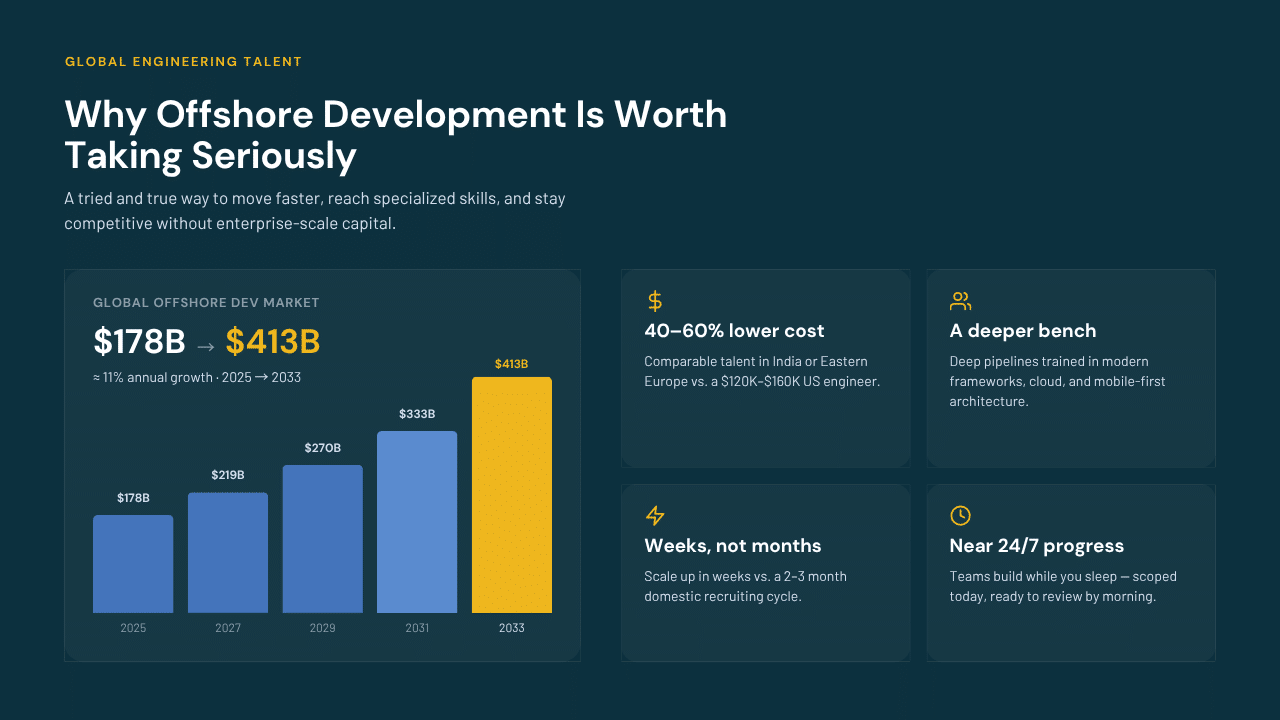
The global offshore software development market was valued at approximately $178 billion in 2025 and is projected to nearly double to $413 billion by 2033, growing at roughly 11% annually. Businesses across every industry are tapping into global engineering talent not just to cut costs, but to move faster, access specialized skills, and stay competitive in markets where standing still means falling behind.
So what is driving this adoption?
Real cost difference. A mid-level US software engineer runs $120,000–$160,000 in salary alone, before benefits and overhead. Comparable talent in markets like India or Eastern Europe often costs 40–60% less. For a small business building a serious product without enterprise capital, that gap can be the difference between launching and not launching.
A talent pool that’s bigger than you think. Countries like India have built deep pipelines of engineers trained in modern frameworks, cloud infrastructure, and mobile-first architecture. Charlotte’s local market is strong but competitive and constrained, so offshore expands your options dramatically.
Faster scaling. Adding three engineers domestically is a two-to-three-month recruiting cycle. With an established offshore team, we’re talking mere weeks.
The time zone gap can work for you. When structured right, an overseas team executes while you sleep. Features scoped in the afternoon can be ready for review the next morning, turning a potential headache into a near-continuous development cycle.
Where Traditional Offshore Gets Complicated
If you have spent time at RevTech Labs, Packard Place, or the startup meetup circuit in Charlotte, you have almost certainly heard someone’s offshore horror story. The product that came back wrong, the team that went silent, or the launch that missed by six months. These stories are common, but not inevitable; and they follow predictable patterns.
Communication breaks down without a local anchor. Software development is high-context. Requirements shift mid-sprint, and a misunderstood message can mean a week of rework. When your entire team is twelve time zones away with no US-based point of contact, small miscommunications compound fast. Having a local technical lead who bridges that gap eliminates most issues before they reach your inbox.
Cultural and market context gets lost. Software built for American consumers has specific nuances: checkout flows, accessibility expectations, UX conventions users take for granted, even copy utilized. A team that has never lived in that context can ship code that is technically correct but experientially off. Someone embedded in the US market who can flag those disconnects early makes a significant difference in the final product.
Process discipline varies wildly. Some offshore shops run tight agile sprints with rigorous QA. Others are brilliant at writing code but structurally chaotic, with weak sprint planning, no regression testing, messy documentation. If you are a non-technical business owner, you often cannot tell the difference until something goes wrong. Partners with structured project management built in, defined milestones, regular code reviews, clear QA, are the ones worth evaluating.
You can end up becoming an accidental tech manager. The worst version of traditional offshore is a business owner spending two hours every night reviewing pull requests across continents. That is not leverage. The right structure means your job is to communicate business goals clearly, and someone else’s job is to translate those goals into execution.
What Getting It Right Actually Looks Like
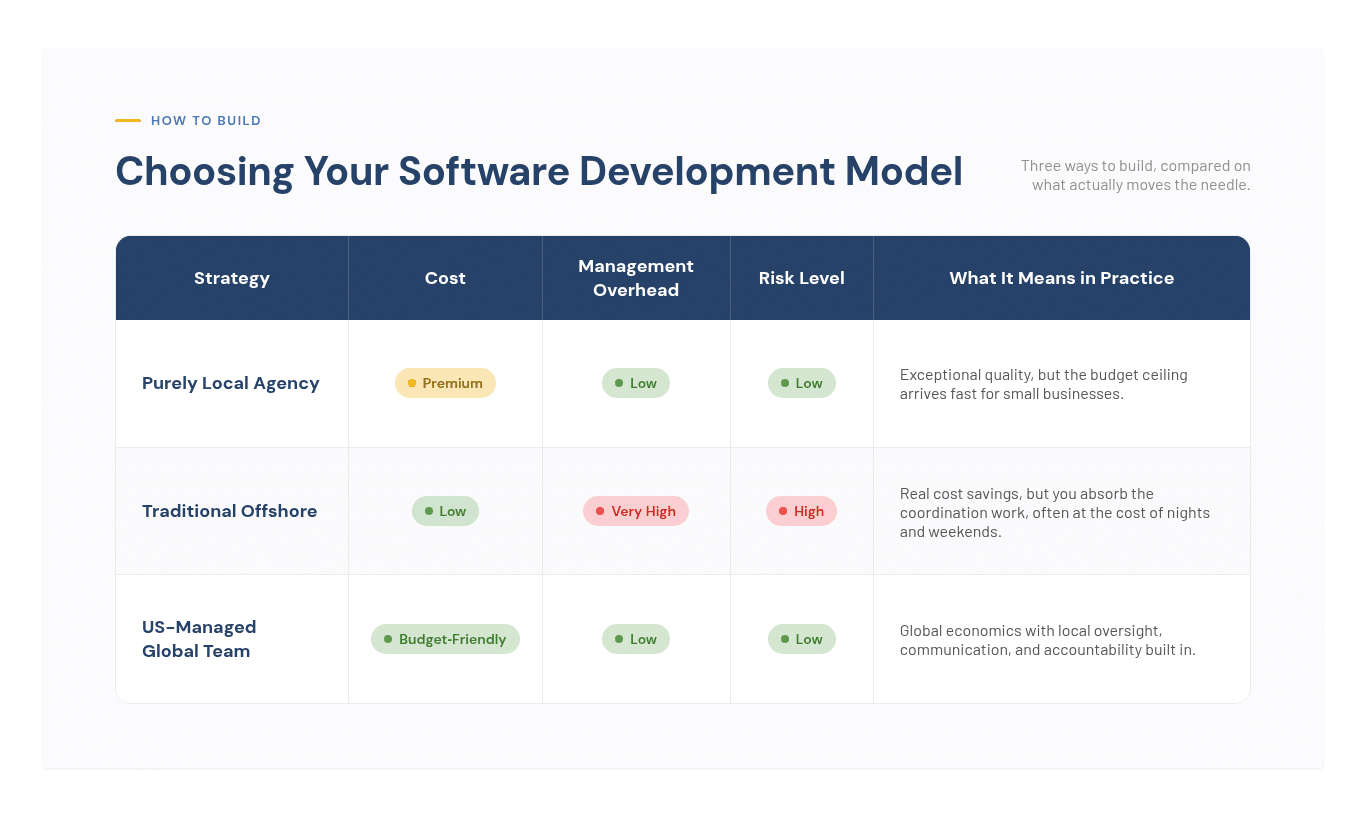
The model that sidesteps most of these friction points combines US-based technical leadership with a dedicated overseas engineering team. Your primary relationship is with someone local: a project lead who attends strategy sessions during Charlotte business hours, understands your industry, and manages the global team on your behalf.
The time zone gap becomes an advantage. Scope priorities in the afternoon, review progress the next morning. When requirements shift, there is someone local who absorbs the change and re-routes the team without it spiraling into a two-day thread across continents. It is not a workaround for offshore’s weaknesses. It is the configuration offshore works best in, that you as a business owner can capitalize on.
Here at Rubico, we call it “Dualshore.”
Making the Call
Offshore development is not inherently risky. Unmanaged offshore development is.
The businesses that get the most out of global engineering talent treat partnership structure as seriously as they treat cost. Before signing anything, ask: who owns communication on the US side? How are sprints managed? What does QA look like? Those questions will tell you more about a vendor’s reliability than their portfolio ever will.
At Rubico, we have built our model around exactly this structure: domestic US strategy and oversight paired with a deeply experienced engineering team in India. If you want to talk through what that could look like for your business, we would be happy to jump on a quick call and help you explore your Dualshore options.