Three Tools That Demonstrate the Range of Vibe Coding Capabilities
You have the idea. You can see it working. But between that flash of inspiration and showing something real to investors, customers, or your team lies the “proof-of-concept valley.”
Traditionally, crossing this valley meant months of development and tens of thousands of dollars just to test if an idea had legs. In 2026, that is no longer the case. A new era of “vibe coding” has emerged, where software development is decoupled from manual syntax mastery, allowing founders to build at 10-20x the traditional velocity.
To skip the valley, you need the right tool for your specific bottleneck. Here are the three industry leaders that are collapsing the time between idea and working prototype from months to days.
1. v0.dev: The High-Fidelity UI Architect
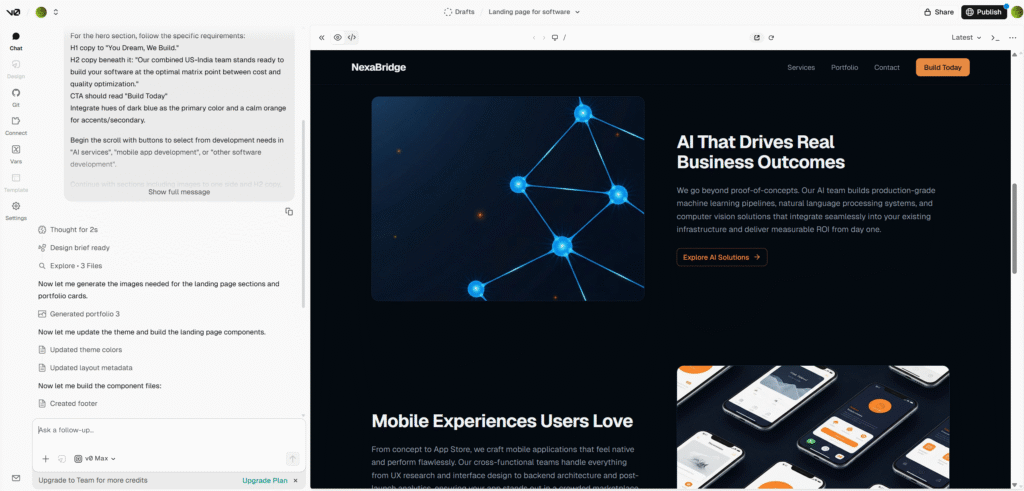
Best for: Developers and designers who need production-grade React components and polished user interfaces that look “pixel-perfect” out of the box.
What it does: v0 has evolved from a simple component generator into a sophisticated AI builder with agentic capabilities. It transforms plain English descriptions into high-quality code using Next.js, Tailwind CSS, and shadcn/ui.
Why it matters: Unlike earlier tools that generated static mockups, v0 produces clean, maintainable code that professional engineers respect. It handles modern design standards, including dark mode and ARIA accessibility, without being prompted.
The Reality Check: While v0 is unparalleled for frontend scaffolding, it still leaves a “Component-to-App Gap”. Transforming a v0 UI into a full product with authentication and database logic can still require significant manual integration work—often 60+ hours for a full MVP. Additionally, intensive use can lead to “credit burnout,” where active development costs exceed the base $20/month subscription.
2. Lovable.dev: The Full-Stack MVP Engine
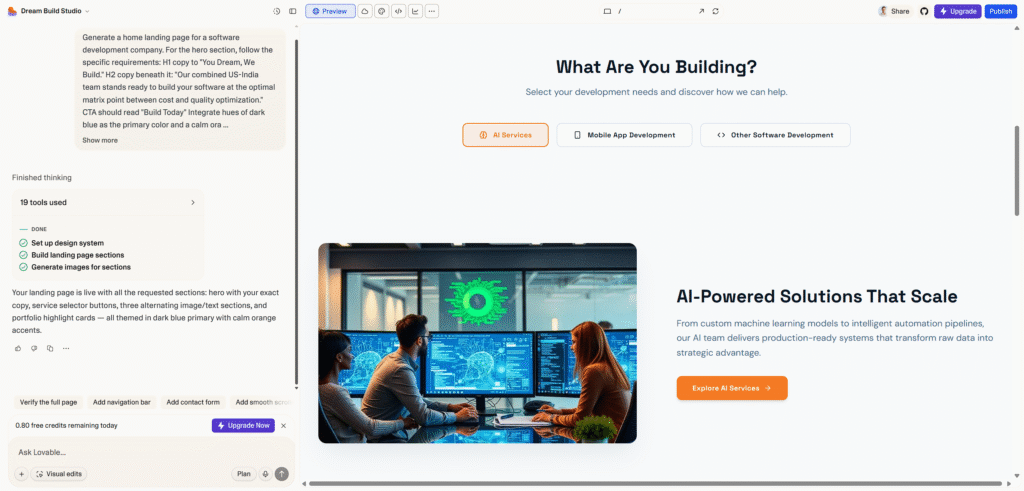
Best for: Early-stage founders who need a functional, data-driven web application with a working backend and user authentication.
What it does: Lovable (formerly GPT Engineer) is a powerful “text-to-web app” platform. It doesn’t just generate UI; it builds real applications by natively integrating with Supabase to handle databases, user authentication (like Google/Apple sign-in), and even Stripe payments.
Why it matters: Most prototyping tools stop at the “clickable mockup.” Lovable builds the “other 80%” of the app—the data layer. You can describe an entire marketplace or SaaS tool, and Lovable handles the backend infrastructure automatically. It also features a “Select to Edit” tool that allows you to click any element and describe a change, drastically reducing technical debt.
The Reality Check: Lovable is designed for simple new applications. If you are integrating with complex legacy systems, you will likely still need a developer to bridge the gaps. While it includes minor “branding” features like favicon generation, its true power is full-stack engineering, not graphic design. It’s important to note that it’s still important to review code from Loveable to ensure proper functionality, and that you’re likely to run into walls as complexity compounds.
3. Cursor: The Professional Engineering Partner
Best for: Technical founders or small engineering teams who need to move fast within an existing codebase or scale a prototype into a robust product.
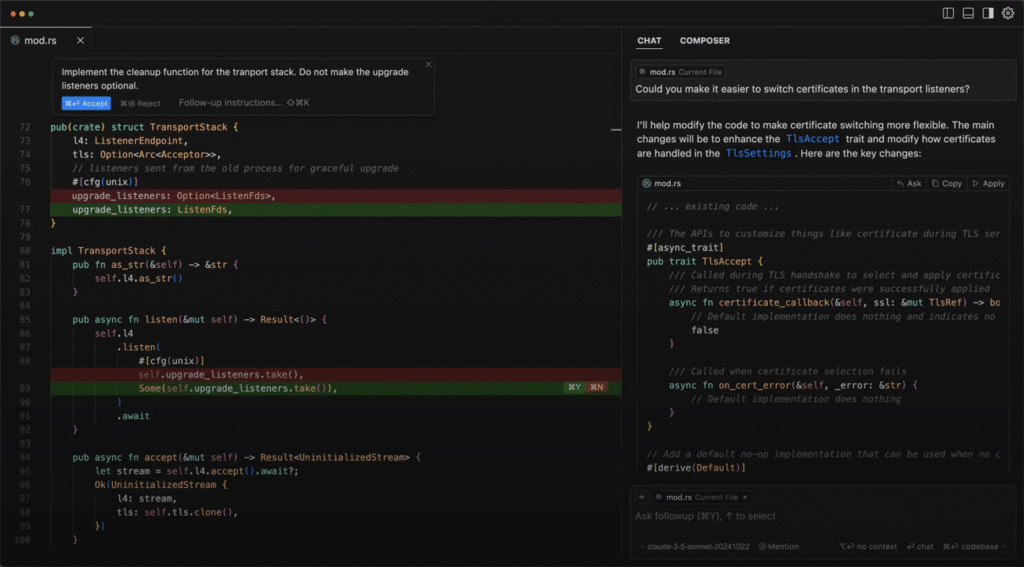
What it does: Cursor is a fork of VS Code that has become the industry standard for “agentic coding”. Because it indexes your entire repository, it has deep codebase awareness. You can use its “Composer” mode to execute multi-file refactors—like updating an API endpoint and every file that calls it—simultaneously.
Why it matters: Cursor’s “Agent Mode” can autonomously run terminal commands, execute tests, and fix its own bugs. It’s used by engineers at firms like Stripe and NVIDIA because it acts as a “Synthesis Engineer,” handling the boilerplate while the human acts as the architect.
The Reality Check: For “Power Users” running multiple agents or long-running tasks, the $20/month Pro plan may not be enough. Heavy automation can push costs toward $200/month or more.
The “Final 40%” Warning
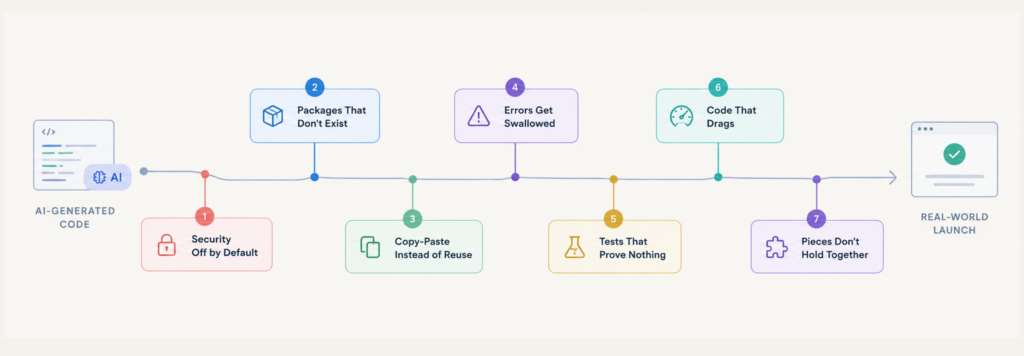
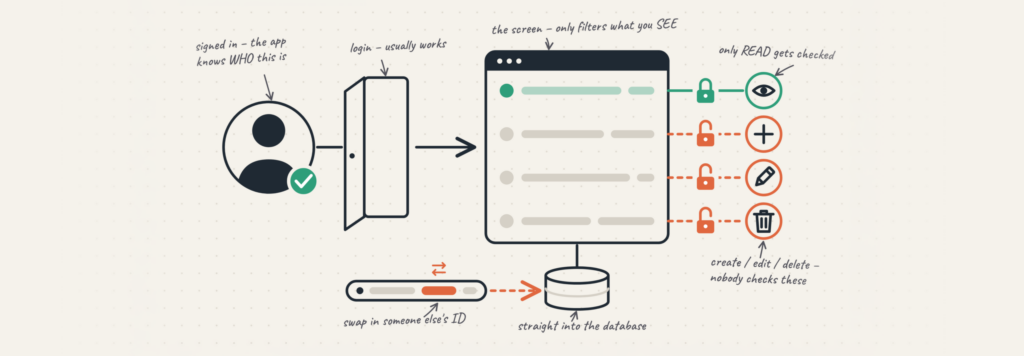
While these tools excel at getting you from 0 to 1, the “vibe coding” movement carries risks. In 2026, industry reports suggest nearly 45% of AI-generated code contains security vulnerabilities. Successful founders use AI to prove value quickly but must rapidly transition to “Synthesis Engineering”—a workflow where a human maintains architectural authority to ensure the final product is secure, scalable, and maintainable.
If you’ve used these tools to prove your concept and are ready to move toward a production-ready application that can handle real growth, that is where we come in. We bridge the gap between an AI-generated demo and a robust, scalable business.
Ready to cross the valley? Get in touch with our team here.