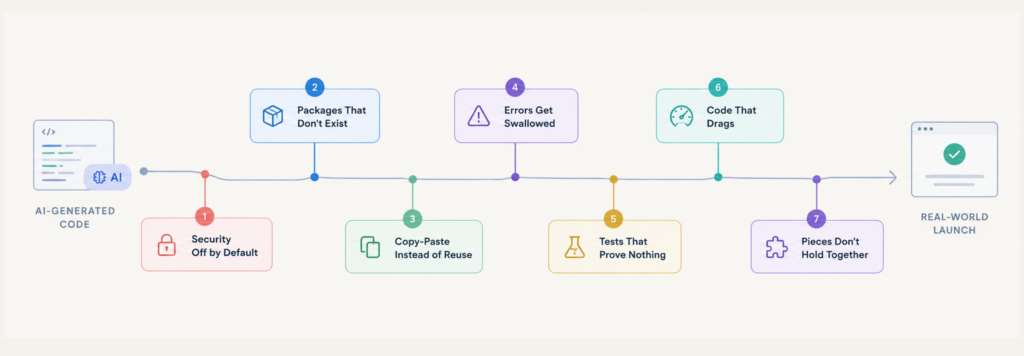
You’ve built something real. Maybe in Loveable, Replit, Base44, or Bolt? But here’s what potentially stands between your vibe-coded prototype and a product that can handle the world.
The Three S’s of Vibe Coding
Vibe coding can be a genuine accelerant, compressing what once took months into days. For the right kind of builder, it makes the leap from idea to working prototype feel almost effortless. If you’re new to the movement, a good place to start is our Vibe Coding Encyclopedia where we’ve covered the full landscape of platforms, tools, and terminology.
But this post is for those of you who’ve already built something and are starting to sense the friction. It’s time to talk about vibe coding security and risks. Maybe you vibe coded a product and the users are arriving. Or maybe you need to secure or stabilize the infrastructure to your product before the customers arrive. Perhaps feature requests from early users are piling up. The code that initially felt seamless and incredible is now beginning to feel…fragile.
What you’re approaching is what we call The Wall.
The Wall isn’t a failure, it’s a milestone. It’s the threshold where the speed and intuition of vibe coding meet the structural demands of production-grade software. Every serious project eventually reaches it, and how you respond determines whether your prototype becomes a product or a cautionary tale.
To break through The Wall, to get your product from prototype to production, you need your product to meet The Three S’s: Security, Scalability, and Systems. Each one represents a category of risk that vibe coding, by its nature, tends to leave unaddressed. And each one, if left unchecked, can quietly undo everything you’ve built.
1. Security: Protect What You’ve Built
When you’re in vibe mode, your entire focus is the build. You want to see the feature live. You want to feel the momentum. That mindset is exactly what makes vibe coding so powerful in the early stages and exactly what makes it dangerous when real users and real data enter the picture.
AI models are optimized to make things work, not to make them safe. They choose the fastest path to a functional result every time, and security considerations rarely live on that path. Here’s where that tends to show up:
- Exposed credentials: AI will often write API keys and database passwords directly into your code — not out of negligence, but because it’s the most direct route to a working result. If that code ends up in a public repository (and it often does), automated bots will find those keys within minutes and exploit them. Professional developers store credentials in dedicated secret managers, keeping them out of the codebase entirely.
- Unvetted dependencies: To save time, AI frequently pulls in third-party libraries without checking whether those libraries are actively maintained or whether they contain known vulnerabilities. Supply chain attacks, where malicious code is embedded in a dependency, are one of the fastest-growing threats in modern software. Automated dependency scanning tools catch these risks before they become your problem.
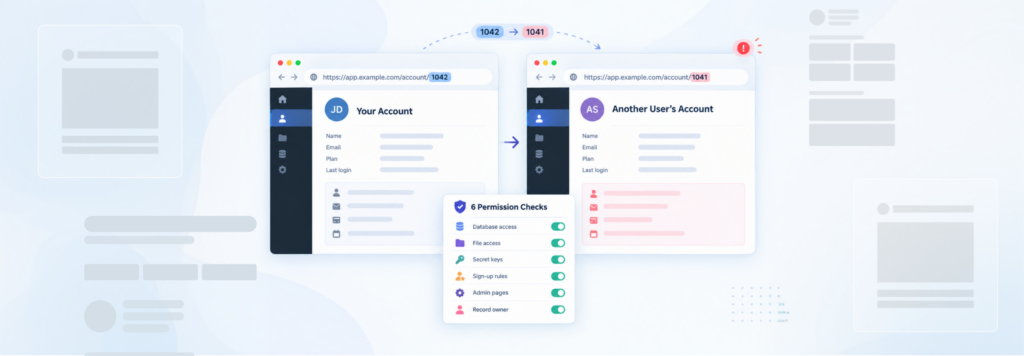
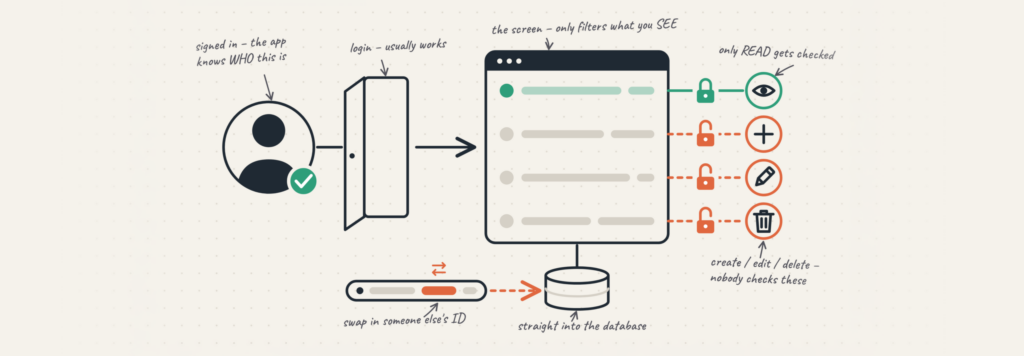
- Broken access control: Without explicit instruction, AI doesn’t inherently understand your user hierarchy. It may write code that allows a standard user to access administrative data simply because it wasn’t told otherwise. Implementing Role-Based Access Control (RBAC) correctly requires intentionality, which is something that’s easy to skip when you’re moving fast.
Security isn’t a feature you add later. By the time you’re thinking about it, the vulnerability may already exist. The shift from Builder to Protector has to happen before you have users to protect. (This is one of the first things we audit when a founder brings us a vibe-coded project.)

2. Scalability: Designing for the Heavy Lift
A vibe-coded app that works beautifully in demo conditions can fall apart the moment real-world traffic arrives, especially when success arrives faster than expected. This is one of the most common, and most painful, moments in a product’s lifecycle: you get a surge of users, something breaks, and suddenly the success you worked toward becomes the problem you’re scrambling to fix.
AI generates code for what engineers call the “happy path.” This is the ideal scenario where one user, with good data, performs one action at a time. Real products don’t work that way.
- Database performance: A query that runs in milliseconds against 100 rows of data can take 30 seconds against 100,000. AI-generated database queries are often unindexed, meaning the database scans every row every time to find what it needs. A developer adds indexes, essentially a lookup table for your data, so queries remain fast as your user base grows.
- Concurrency: What happens when 500 people click “Purchase” at the same moment? Without proper transaction locking, vibe-coded apps will often process all 500 simultaneously, leading to double-billing, oversold inventory, and corrupted records. These aren’t edge cases once you’re at scale — they’re inevitable (and can be disastrous).
- Cost-efficiency: If your app makes an expensive API call for every minor user interaction, your infrastructure costs will scale faster than your revenue. Professional engineering involves refactoring those calls to be lean: using caching, batching requests, and processing data efficiently so your margins stay healthy as you grow.
Scalability isn’t just a technical concern, it’s a business one. The engineering choices made at the prototype stage tend to calcify quickly, which is why addressing them before you scale is significantly cheaper than fixing them after.

3. Systems: Building Something That Lasts
This is the area where the gap between vibe coding and professional engineering is widest and where the consequences of ignoring it compound the most over time.
AI generates code in fragments, responding to each prompt in relative isolation. The result, across many sessions and many features, is what developers call spaghetti code: poorly structured, tangled logic where changing one thing breaks three others, and no one, not even the AI that wrote it, can confidently trace why. This is the technical debt of vibe coding, and its accumulation is silent but deadly.
Building a system that lasts requires three things:
- Modular architecture: Rather than one large, entangled codebase, professional developers organize code into small, independent modules — each responsible for one thing. This means you can swap your payment provider without rewriting your authentication system. You can redesign your UI without touching your business logic. The app becomes something you can change safely, not something you’re afraid to touch.
- Automated testing: When you vibe code, you test manually: you click around, check that things look right, and ship. But manual testing doesn’t scale, and it doesn’t catch the subtle breakages that come from changing one part of the code and inadvertently affecting another. Unit tests are automated scripts that run every time you make a change, confirming that the core of your application still works. They’re the safety net that makes it possible to move fast without breaking things.
- Readable, documented code: AI writes code that is functional but often opaque. There are rarely comments explaining why a decision was made — only code showing what it does. Six months later, when a bug appears or a feature needs to change, neither you nor a developer nor the AI will be able to understand the original intent without spending hours deciphering it first. Clean documentation and a clear system map are what transform your product from a black box into something that can genuinely be maintained and grown.
These aren’t bureaucratic concerns. They’re what separates a business from a science experiment.
The Wall Is a Milestone, Not a Dead End
Vibe coding can give you something real. The momentum, the speed, the ability to build before you fully know what you are building and it’s changed what’s possible for founders and creators.
But at Rubico, we’ve seen enough projects hit The Wall to know that what happens next matters more than what came before. The builders who make it from prototype to production are the ones who recognize that professional fortification isn’t a retreat from the vibe coding approach, it’s what vibe coding was always supposed to build toward.
If your project is approaching The Wall, that’s not a signal to slow down. It’s a signal to bring in the right expertise.
We help businesses, product managers, and founders transform vibe code to live code, securing what you’ve built, engineering it to scale, and building systems that can carry the weight of real growth.
Ready to take your vibe-coded prototype to production? Contact Rubico today and let’s build something that lasts.